

We built Custom Fuel App around a moment your office never sees: a customer standing at the tank after dark, deciding to buy, with nowhere to put that decision but a voicemail box.
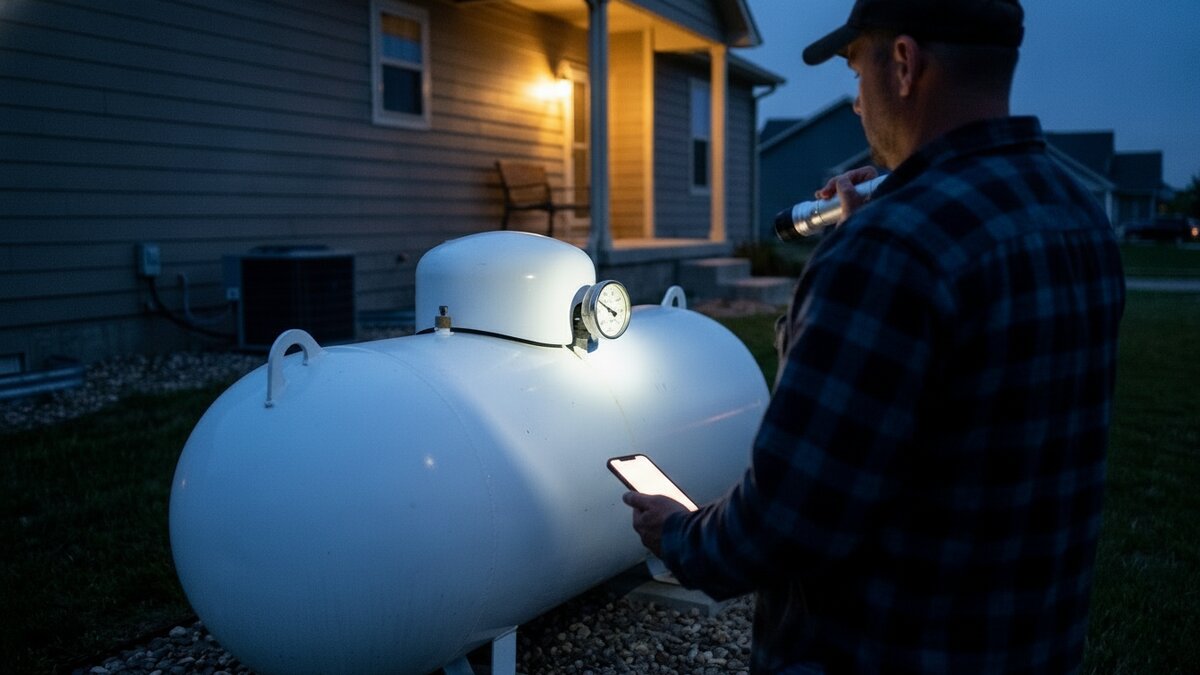
Picture the transaction every propane dealer has run a thousand times. Thursday in November, a little after nine. A customer walks out with a flashlight, reads the gauge, doesn't like the number, and goes back inside to call. The office closed at five. She gets the after-hours greeting, leaves her name, spells her street twice, and guesses at her account number. Friday morning a CSR plays the message, finds two customers with that name, picks one, calls back, and gets voicemail. The customer calls the office herself at two in the afternoon and reads sixteen digits out loud in a parking lot. The fill goes on next week's route.
Nothing there is broken. It simply took two employees, three phone calls, and roughly seventeen hours to process an order the customer had fully decided on the night before, standing in her own driveway.
The yardstick she's holding at the tank
Every part of that lag traces back to the telephone. What changed is the standard your customer measures you against while she's out there with the flashlight. She refilled a prescription that morning with two taps. Her bank moved money between accounts while she sat at a light.
The numbers back the habit up. According to Pew Research Center's Mobile Fact Sheet published Nov. 20, 2025, ninety-one percent of U.S. adults own a smartphone — up from 35% when the Center first measured smartphone ownership in 2011. The buying moved with the hardware. E-commerce accounted for 16.9% of total U.S. retail sales in the first quarter of 2026, the Census Bureau reported on May 18, 2026, and that channel grew 9.8% year over year while total retail sales grew 3.9%. Sit with the gap between those two rates. Screens keep taking a larger share of American buying every quarter, and the people doing that buying are the same people reading propane gauges in the dark.
After hours is where the orders are
Call it 45 staffed hours a week on your phone line. That leaves 123 hours in which a customer's decision has nowhere to go. Gauge-checking is an evening activity. So is bill-paying, and Sunday-morning worrying about a cold snap. The moment of highest intent — the second she has decided to buy — lands almost entirely outside business hours, during the months that matter most. You don't lose all of those orders; most people call back. But some fraction won't, and you never see the ones that didn't.
What we actually built
Our app gives your customers one-tap reorder with their payment saved on file, so nobody reads sixteen digits into the wind. They watch delivery status instead of calling to ask where the truck is. We send delivery updates, reminders, and push notifications automatically, which pulls the "where's my propane" calls off your CSRs and moves payment onto the account faster. And at the highest-intent second in the whole cycle — the moment a customer places a will-call order — we offer automatic-delivery enrollment right there. Enroll, and she can stop thinking about the gauge.
The order lands in your existing queue, matched to the right account, with a confirmation the customer can see. That last part carries weight. An app that drops requests into a shared inbox has recreated the voicemail problem with better graphics; ours doesn't. You supply a logo, brand colors, a hero photo, and a feature priority list. We handle the design, the integration, and both store submissions, with no developer on your side.
What you can measure Monday morning
Before you talk to any vendor, pull last month's inbound call log. Count how many calls were nothing but a reorder — no billing question, no service issue, no complaint attached. Then count the after-hours voicemails, and mark how many turned into a delivery and how many went cold. Those two numbers describe what a digital ordering lane is worth in your specific operation, and you can count them this week.
One objection always comes up: the idea that propane customers are too old or too rural for an app. Some won't use it. But 96% of U.S. adults use the internet, per Pew Research Center's Internet, Broadband Fact Sheet published Nov. 20, 2025, and the retired schoolteacher on a five-hundred-gallon tank has been video-calling grandchildren for a decade. Your phone line stays open, staffed, and answered. The app just adds a lane.
Your customers grade you against the last app they opened that day. See what one built for propane looks like, and request a demo at customfuelapp.com. This piece began as our reporting in Propane Insider.
First published in Propane Insider.